General chatbot vs source-grounded research tool at a glance
| Question to ask of any AI answer | General chatbot (ChatGPT, Gemini, Claude, used on their own) | Source-grounded legal tool (e.g. DIKIGOROS AI) |
|---|---|---|
| Where does the answer come from? | Patterns learned in training, sometimes plus a web search | Cyprus judgments and legislation retrieved first, then summarised |
| Can I click through to the judgment? | Rarely for Cyprus; links, if any, are to secondary web pages | Yes, each footnote opens the judgment or provision |
| Does it know the post-2023 courts and the NCPR? | Depends on training date and what it happens to find | Indexed decisions up to the latest published, old CPR and NCPR 2023 side by side |
| Does it say what it could not find? | Usually not; it fills the gap with plausible text | Flags a "gap" where the sources do not settle the point |
| Greek-language sources | Weak unless you ask in Greek, and even then patchy | English or Greek questions matched against Greek judgments |
| Client data | Consumer terms vary; check training and retention settings | EU data residency (Frankfurt), GDPR |
The safest workflow is the same whichever tool you use: let the AI point you to authorities, then read them on CyLaw (cylaw.org) before you cite them. You can try DIKIGOROS AI Professional free for 3 days at dikigoros.ai (card required; €20 a month after that, cancel any time before).
Is ChatGPT reliable for Cyprus legal research?
Not on its own. A general chatbot predicts likely text. Even with web search switched on, it depends on what the open web says about Cyprus law, which is not much.
The English High Court put it plainly in June 2025. In Ayinde v London Borough of Haringey [2025] EWHC 1383 (Admin), the Divisional Court said freely available generative AI tools "are not capable of conducting reliable legal research". Lawyers who use them must check the output against authoritative sources.
The same applies in Cyprus. ChatGPT, Claude or Gemini can help you brainstorm issues or draft an outline. They should not be your source for what the law is.
Why do general chatbots struggle with Cyprus law?
The primary sources are in Greek
Almost all Cyprus judgments since the late 1980s, and all authentic legislation, are in Greek. Only the Greek text published in the Official Gazette (Επίσημη Εφημερίδα της Δημοκρατίας) is authentic. English versions exist only for older Supreme Court reports (the Cyprus Law Reports, C.L.R.) and for a limited set of official translations by the Office of the Law Commissioner.
Asked in English, a chatbot leans on English-language material: for Cyprus, mostly law-firm articles, news and old C.L.R. volumes.
The web footprint is small and the volume is large
Cyprus courts publish about 5,000 decisions a year: 5,022 in 2023, 5,070 in 2024 and 5,089 in 2025 in the DIKIGOROS AI index (September 2026). The index holds 95,623 decisions from 1960 to 2026, linked by more than 900,000 citations.
Little of it is discussed in English online, and a model that has seen few real Cyprus cases is more likely to produce a plausible one that does not exist.
Consolidated text vs amended text
Cyprus statutes are amended by separate amending laws, numbered by year, for example Ν. 145(Ι)/2022, the law that created the Court of Appeal. The consolidated text on CyLaw reflects those amendments, but a chatbot may have learned an older version. It can quote a subsection that has since been replaced, or number a section that was renumbered.
The 2023 court reform changed who decides what
Since 1 July 2023, Cyprus has had a three-tier court system. A new Court of Appeal (Εφετείο) of 16 judges hears appeals from first-instance courts. The former Supreme Court was split into the Supreme Constitutional Court (Ανώτατο Συνταγματικό Δικαστήριο) and the Supreme Court (Ανώτατο Δικαστήριο), which now sits at third instance with leave.
Much of the web still describes the pre-2023 structure. In the DIKIGOROS AI index, about one in six decisions (roughly 15,700) is dated 2023 or later. Of those, the Court of Appeal accounts for about 1,100 and the Supreme Constitutional Court for about 400. A model trained mostly on older text may barely know this case law.
NCPR 2023 vs the old Civil Procedure Rules
The new Civil Procedure Rules (Θεσμοί Πολιτικής Δικονομίας 2023) came into force on 1 September 2023 and apply to claims filed from that date. Older actions continue under the previous rules. Two procedural systems therefore run side by side, and a chatbot rarely asks which one applies before answering.
What does ChatGPT typically get wrong about Cyprus law?
Invented or misattributed case citations
The most dangerous error. The model produces a case name, a report citation in the familiar (year) part Α.Α.Δ. page format and a confident summary. Sometimes the case does not exist; sometimes the parties exist but the citation points to a different case; sometimes the case is real but says nothing like what the chatbot claims.
UK law presented as Cyprus law
Cyprus law has strong common-law roots, and English decisions are often cited as persuasive authority. Chatbots, trained mostly on English-language sources, tend to answer a Cyprus question with UK statute. A familiar example: directors' duties explained by reference to the UK Companies Act 2006, which does not apply in Cyprus, instead of the Companies Law, Cap. 113 (Ο περί Εταιρειών Νόμος, ΚΕΦ.113) and Cyprus case law.
Outdated or wrong section numbers
Answers may cite a section that was repealed, renumbered or substantially amended, or give the right rule under the wrong law.
The wrong court, or the wrong procedure
A chatbot may tell you an appeal goes to "the Supreme Court of Cyprus", which was correct before July 2023 for most appeals but is not now. It may also describe a step, a form or a deadline from the old Civil Procedure Rules for a claim that is governed by the NCPR, or the reverse.
Missing ECLI and case-number details
Many Cyprus decisions have no European Case Law Identifier (ECLI). In the DIKIGOROS AI index about 46,600 decisions carry one; among decisions from 2023 onwards, roughly four in five do not. A chatbot that invents an ECLI for a recent first-instance decision is a red flag. See our guide on how to cite Cyprus judgments.
What have courts done about AI-hallucinated case law?
We found no Cyprus judgment on AI-invented citations, in our index or in public sources, when this article was prepared. Courts elsewhere have already acted.
| Case | Court and date | What happened |
|---|---|---|
| Mata v. Avianca, Inc., 678 F. Supp. 3d 443 | US District Court, S.D.N.Y., Judge P. Kevin Castel, 22 June 2023 | Lawyers filed a brief citing cases invented by ChatGPT, then stood by them after they were questioned. The court found bad faith and imposed a $5,000 penalty, and ordered letters to the client and to the judges falsely named as authors. |
| R (Ayinde) v London Borough of Haringey [2025] EWHC 1383 (Admin), heard with Al-Haroun v Qatar National Bank | Divisional Court of the King's Bench Division (Dame Victoria Sharp P), 6 June 2025 | The court reviewed two cases in which fictitious authorities or false quotations were put before the court. It warned that generative AI tools cannot do reliable legal research, restated the duty to check against authoritative sources, and referred the lawyers to their regulators. It declined to start contempt proceedings but said that decision "is not a precedent". |
The lesson from both is the same: the duty to verify sits with the person who puts the authority before a court or a client. Saying "the AI gave it to me" is not a defence.
Is there Cyprus guidance on lawyers using AI?
Yes, indirectly. On 2 October 2025 the Council of Bars and Law Societies of Europe (CCBE) published a guide on the use of generative AI by lawyers. The Technology Committee of the Cyprus Bar Association prepared a Greek summary and circulated it to members in October 2025, asking them to read the full guide as well.
The summary stresses four points: verify AI output before use; understand the tools' limits; do not enter personal or confidential data without safeguards; and consider telling clients how AI is used on their matter.
The President of the Supreme Constitutional Court said in an interview published at the end of August 2026 that guidelines on judges' use of AI systems are being drafted. We found no published Cyprus court practice direction on AI use by advocates at the time of writing.
At EU level, Article 4 of the AI Act (Regulation (EU) 2024/1689) has applied since 2 February 2025. It requires organisations that deploy AI systems, law firms included, to take measures to support AI literacy among staff who use them.
How do you verify an AI answer on Cyprus law? A 6-step checklist
- Find every authority in a primary source. Search each case on CyLaw by party names, case number or report citation, and each statute in the legislation index at cylaw.org/nomoi. If you cannot find it, treat it as invented.
- Read the passage, not the summary. Open the judgment and find the paragraph that supports the proposition. Check the quotation word for word.
- Check the law is current. Compare the section the AI quoted with the consolidated text and look for later amending laws (Ν. xx(Ι)/yyyy). Note the consolidation date.
- Check the court and the date. For anything after 1 July 2023, confirm which court decided it and whether it was appealed. Look for later decisions that cite it; a citation explorer or a CyLaw search on the case name will show this.
- Check it is Cyprus law. If the answer cites a UK statute or an English case, ask whether it is binding, persuasive or irrelevant in Cyprus, and find the Cyprus provision that actually governs.
- Keep a record. Save the source links and the date you checked them. If you used AI in client work, record which tool and for what, in line with the CCBE guidance on transparency.
Five test questions: what a reliable answer must contain
We have not run these through any chatbot for this article. Use them as a test yourself: ask your AI tool, then check the answer against the criteria.
| Test question | A reliable answer must... | Red flags |
|---|---|---|
| 1. "Which court hears an appeal against a Limassol District Court civil judgment?" | Name the Court of Appeal (since 1 July 2023), mention that further appeal to the Supreme Court needs leave, and cite the Administration of Justice (Miscellaneous Provisions) Law, Ν. 33/1964, as amended by Ν. 145(Ι)/2022 | "The Supreme Court of Cyprus" as the ordinary appeal court; no date |
| 2. "What is the deadline to file a defence in a civil claim in Cyprus?" | Ask or state whether the claim was filed before or after 1 September 2023, then cite the specific Part and rule of the NCPR or the old rules | One number with no rule reference; UK CPR rule numbers |
| 3. "What are directors' duties under Cyprus company law?" | Cite Cap. 113 and Cyprus judgments by report citation or case number, and treat English authority as persuasive only | Sections 171–177 of the UK Companies Act 2006 presented as Cyprus law |
| 4. "Give me three Cyprus cases on statutory tenancy under the Rent Control Law." | List each case with parties, court, date and a citation you can open on CyLaw, and summarise the actual holding | Cases you cannot find; citations that open a different case; identical summaries |
| 5. "Quote the current text of Article 11 of the Constitution and tell me when it was last amended." | Quote the current consolidated text, list the amending laws by number (Ν. xx(Ι)/yyyy) with their dates, and note that the Greek text is authentic | No amending laws named, no date, a paraphrase presented as a quotation |
A good answer can also say "I could not confirm this". An answer that never admits a gap is the one to distrust most.
Can I paste client documents into ChatGPT? GDPR and confidentiality
Pasting a client's name, facts or documents into a consumer chatbot may disclose confidential information to a third-party provider. It may also involve processing personal data under the GDPR (Regulation (EU) 2016/679) without a proper legal basis, processor contract or transfer safeguards.
Practical rules, consistent with the CCBE guidance summarised by the Cyprus Bar Association:
- Do not enter personal or confidential data into a tool unless there are contractual and technical safeguards: a data processing agreement, clear retention and no-training terms, and EU or EEA processing where possible.
- Read the provider's terms and switch off chat history or model training where the option exists.
- Anonymise facts before asking a general question. "A tenant in Nicosia" is usually enough.
- Treat AI output about a client matter as part of the file and check it like work from a junior colleague.
How DIKIGOROS AI helps you check AI answers on Cyprus law
The difference from a general chatbot is the order of operations. A chatbot writes first and, at best, searches second. A source-grounded tool retrieves the relevant judgments and provisions first, writes only from them, footnotes each point and says where the sources run out. That does not remove your duty to verify; it makes verification fast. For a comparison of the tools on the market, see our guide to the best AI legal research tools in Cyprus.
DIKIGOROS AI searches 95,623 Cyprus court decisions from 1960 to 2026, Cyprus statutes and both the old Civil Procedure Rules and the NCPR 2023. Ask in English or Greek; questions are matched against the Greek judgments, with exact keyword search when you need it.
Worked example: a chatbot told you District Court appeals go to the Supreme Court. In DIKIGOROS AI you could type:
"Since the 2023 reform, which court hears civil appeals from the District Courts? Cite the statute and two recent decisions."
The answer is built from retrieved sources, with footnotes to the provision and to decisions you open in the sources side panel. The citation explorer shows who has cited each decision since, unsettled points are flagged as gaps, and you can export to Word or PDF with citations intact.
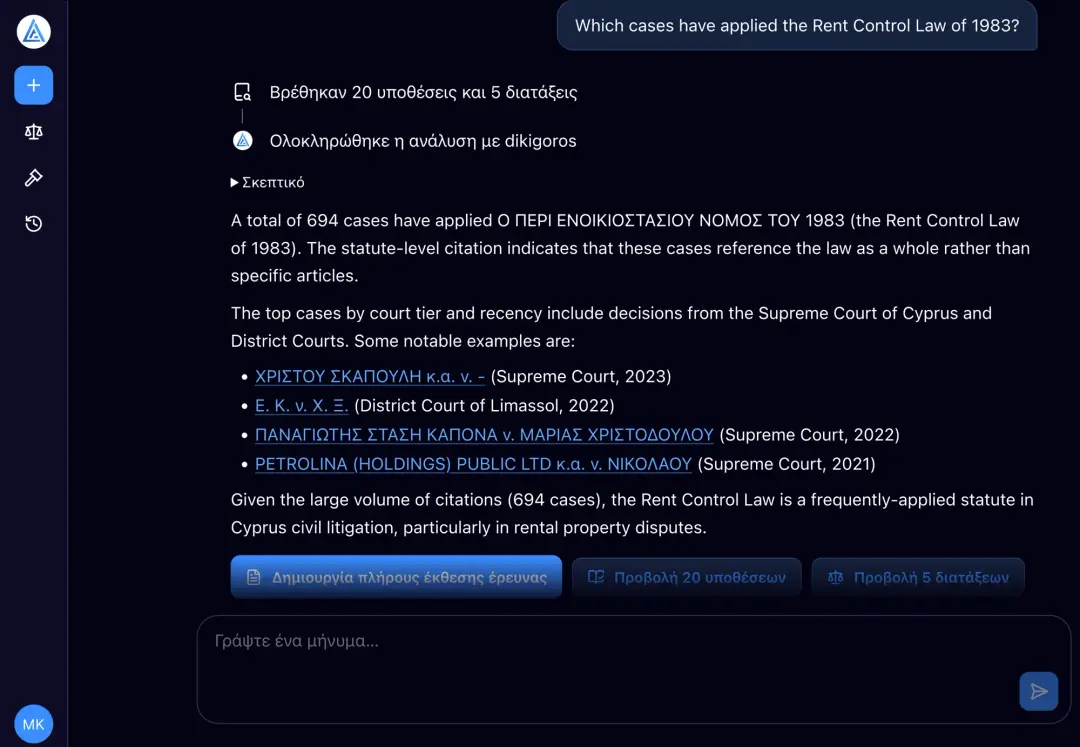
Every new account starts on Free, no card required. Start your free trial at dikigoros.ai/register. You can stay on Free or choose Basic (€5 a month) or Professional (€20 a month). Professional comes with a 3-day free trial; card required, cancel any time before it ends. Law firms and in-house legal teams can choose Firm (€45 per seat a month), which adds Matters (case-file workspaces where you upload the documents for each matter and pin the authorities you rely on), seats and a firm dashboard. Prices exclude VAT; see pricing.
Frequently asked questions about using ChatGPT for Cyprus law
Can I use ChatGPT for Cyprus legal questions?
Yes, to understand concepts, outline issues or prepare questions for a lawyer. Do not rely on it for what the law currently is: check every case, section or rule it gives you on CyLaw before using it.
Is ChatGPT reliable for legal research?
Not on its own. In 2025 the English Divisional Court said freely available generative AI tools cannot conduct reliable legal research. They can produce confident, plausible answers that cite non-existent cases or misquote real ones.
Has any lawyer been sanctioned for citing AI-generated fake cases?
Yes, abroad. In Mata v. Avianca (S.D.N.Y., June 2023) lawyers were fined $5,000 for citing ChatGPT-invented cases. In Ayinde v London Borough of Haringey [2025] EWHC 1383 (Admin), the English court referred lawyers to their regulators over fictitious authorities. We found no Cyprus judgment on the point when this article was prepared.
Does the Cyprus Bar Association have rules on AI?
The Cyprus Bar Association circulated a Greek summary of the CCBE's guide on generative AI for lawyers (2 October 2025) and asked members to follow its recommended practices. These include verifying AI output, understanding the tools' limits and protecting client confidentiality and personal data.
Can I paste client information into ChatGPT?
Only with safeguards. Entering names, facts or documents can breach professional confidentiality and the GDPR. Anonymise the facts, check the provider's retention and training terms, and prefer tools that process data in the EU under a data processing agreement.
How do I check whether a Cyprus case cited by AI is real?
Search CyLaw by party names, case number or report citation, and open the full judgment. Confirm the court, the date and the paragraph that supports the point. If you cannot find it, treat it as invented.
What changed in 2023 that chatbots often miss?
On 1 July 2023 Cyprus created a Court of Appeal and split the old Supreme Court into the Supreme Constitutional Court and the Supreme Court. On 1 September 2023 the new Civil Procedure Rules took effect for new claims. Answers based on older material may name the wrong court or the wrong procedure.
Conclusion
ChatGPT and other general chatbots are useful for thinking and drafting, and unreliable as a source of Cyprus law. Greek-language sources, frequent amendments and the 2023 reforms push them towards confident mistakes. Verify every authority, keep client data out of consumer tools, and use a research tool that shows you its sources. For a full guide to the underlying databases, read our CyLaw guide.
Try the source-first approach yourself: start a free 3-day Professional trial of DIKIGOROS AI (card required; cancel any time before it ends).
Sources
- R (Ayinde) v London Borough of Haringey; Al-Haroun v Qatar National Bank [2025] EWHC 1383 (Admin), 6 June 2025, bailii.org/ew/cases/EWHC/Admin/2025/1383.html
- Mata v. Avianca, Inc., No. 22-cv-1461 (PKC), Opinion and Order on Sanctions, S.D.N.Y., 22 June 2023, 678 F. Supp. 3d 443
- Cyprus Bar Association, "Σύνοψη Οδηγού αναφορικά με τη χρήση της Παραγωγικής Τεχνητής Νοημοσύνης (GenAI) από δικηγόρους", cyprusbarassociation.org (October 2025)
- CCBE, Guide on the use of generative AI by lawyers, 2 October 2025, ccbe.eu
- European Commission, "AI Literacy – Questions & Answers" (Article 4 of Regulation (EU) 2024/1689), digital-strategy.ec.europa.eu
- Supreme Court of Cyprus, Annual Review 2024 (court reform of 1 July 2023; Civil Procedure Rules in force 1 September 2023), supremecourt.gov.cy
- Ministry of Justice and Public Order, "Courts' Reform: Strengthening the Justice System", gov.cy/mjpo
- European Commission, 2023 Rule of Law Report, Country Chapter Cyprus
- Regulation (EU) 2016/679 (GDPR), eur-lex.europa.eu
- CyLaw, legislation index, cylaw.org/nomoi
- DIKIGOROS AI index of the CyLaw corpus, internal statistics, September 2026
Last reviewed 30 September 2026. General information, not legal advice. Only the Greek text published in the Official Gazette is authentic.