The Cyprus Civil Procedure Rules 2023 at a glance
| Fact | Detail |
|---|---|
| Official name | Οι Κανονισμοί Πολιτικής Δικονομίας του 2023 (Procedural Rule 13/2023) |
| Approved by the Supreme Court | 19 May 2021 |
| Published in the Official Gazette | 3 July 2023 |
| In force | 3 July 2023 for the Court of Appeal; 1 September 2023 for proceedings filed from that date (Part 60.1) |
| Applies to | Civil jurisdiction of the District Courts (Part 2.1), appeals (Part 41), Commercial Court (Part 42), Admiralty Court (Part 43) |
| Structure | 60 Parts; Appendix A (100 forms); Appendix B (advocates' fees) |
| Amendments | Gazette of 29.9.2023, 13.10.2023, 26.7.2024 and 7.8.2026 |
| Official text | Consolidated text on supremecourt.gov.cy; base and amending rules on cylaw.org |
You can try DIKIGOROS AI Professional free for 3 days at dikigoros.ai (card required; €20 a month after that, cancel any time before). It holds both sets of Civil Procedure Rules with their forms and amendment history, linked to the decisions that apply them.
When do the new Civil Procedure Rules apply?
Part 60 sets two start dates. For the new Court of Appeal (Εφετείο) created by the 2023 judicial reform, the Rules apply from 3 July 2023 (see the Cyprus court system after the 2023 reform). For everything else they apply to proceedings filed from 1 September 2023.
Two qualifications matter. The Rules do not displace special procedures governed by their own rules under a specific law, unless that law refers to the civil procedure rules (rule 60.1(3)). And in a case begun before 1 September 2023, a judge exercising a discretion may take into account the principles of the new Rules, especially Part 1 and Part 30 (rule 60.2).
So a claim issued in August 2023 by writ of summons (κλητήριο ένταλμα) runs under the old Orders, and one issued in September 2023 by claim form (έντυπο απαίτησης) under the NCPR. Check which Rules governed any procedural authority before relying on it.
What is the overriding objective?
Part 1 makes the Rules a procedural code whose overriding objective (πρωταρχικός σκοπός) is to enable the court to deal with cases justly and at proportionate cost. That includes equal footing, saving expense, proportionality, speed, fairness and enforcing compliance (rule 1.2). The parties must help the court further it (rule 1.4); the court furthers it by actively managing cases (rule 1.5).
How are the NCPR structured? A Part-by-Part map
The 60 Parts follow the life of a claim.
| Stage | Parts | Key forms |
|---|---|---|
| General | 1 Overriding objective; 2 Application and interpretation; 3 Case and costs management powers, including pre-action protocols; 4 Forms; 5 Court documents | – |
| Service | 6 Service, including service out of the jurisdiction (Section V) | 1–3 |
| Starting a claim | 7 Claim form; 8 Alternative procedure (no substantial dispute of fact) | 4 (claim form), 5, 7 |
| Responding | 9 Response; 10 Appearance; 11 Discontinuance; 12 Disputing jurisdiction | 10 (appearance), 11 |
| Judgment without trial | 13 Default judgment; 14 Setting aside default judgment; 15 Admissions; 24 Summary judgment | 15–20 |
| Statements of case | 16 Pleadings; 17 Defence and reply; 18 Amendments; 19 Further information; 20 Parties; 21 Counterclaims; 22 Statements of truth | 21 (defence), 22, 27–31 |
| Applications and interim relief | 23 Applications; 25 Interim remedies; 26 Security for costs; 27 Interim payments | 33–38 |
| Case management | 28 Preliminary stage; 29 Small claims; 30 Ordinary claims | 39 (directions questionnaire), 40–42 |
| Evidence | 31 Disclosure; 32 Evidence; 33 Witnesses and depositions; 34 Experts | 43–51, 52 (witness statement), 53–57 |
| Settlement and trial | 35 Offers to settle; 36 Payments into court; 37 Hearings; 38 Judgments and orders | 58–61 |
| Costs | 39 Costs (with Appendix B) | – |
| Appeals and specialist courts | 40 Change of advocate; 41 Appeals; 42 Commercial Court; 43 Admiralty; 44 Arbitration; 45 European procedures; 46 Interpleader | 62, ΕΕ63–ΕΕ65, ΝΑΥ66–ΝΑΥ91, 92–93 |
| Enforcement | 47–58 Execution, arrest, attachment, possession, delivery, bailiffs, receivers | 94–100 |
| Final | 59 Registry hours and court vacations; 60 Old proceedings | – |
Summary judgment is Part 24 (Συνοπτική Απόφαση). The court may give it for or against either party, on the whole claim or an issue, where that party has no real prospect of success and there is no other compelling reason for a trial (rule 24.2). Default judgment is Part 13, and setting it aside is Part 14.
Which old Orders became which Parts?
There is no official concordance. This table matches the headings of the old Orders (official text of the Θεσμοί) with the Parts now covering the same subject. The content usually differs: use it to navigate, not as authority.
| Subject | Old Rules (Θεσμοί) | NCPR 2023 |
|---|---|---|
| Starting proceedings | Order 2 (writ of summons) | Parts 7 and 8 |
| Service out of the jurisdiction | Order 6 | Part 6, Section V |
| Appearance | Order 16 | Part 10 |
| Default of appearance or pleading | Orders 17 and 26 | Parts 13 and 14 |
| Summary judgment | Order 18 | Part 24 |
| Defence, counterclaim and reply | Order 21 | Parts 17 and 21 |
| Discovery and inspection | Order 28 | Part 31 |
| Summons for directions | Order 30 | Parts 28–30 |
| Appeals | Order 35 | Part 41 |
| Applications | Order 48 | Part 23 |
| Costs; security for costs | Orders 59 and 60 | Parts 39 and 26 |
What changed compared with the old Rules?
Pre-action protocols. Part 3, Section II and Annex I introduced Protocol I (claims for a specified sum), Protocol II (road traffic accidents and personal injury) and Type III for other cases. Under Protocol I the proposed defendant must answer the letter of claim within 14 calendar days. Non-compliance counts in case management and costs (rule 3.10), with exceptions for urgent claims and imminent limitation (rule 3.11).
Claim form and particulars. A claim starts with Form 4 under Part 7, or under Part 8 where the facts are not substantially disputed. Particulars of claim go in the claim form or are filed within 28 days of its service (rule 7.4), and statements of case carry a statement of truth (Part 22).
Case management. Within 28 days of close of pleadings each party files a directions questionnaire (rule 28.2). The court allocates the claim to small claims (€10,000 or less, Part 29) or ordinary claims (Part 30), where a case management conference fixes the timetable.
Disclosure and witness statements. Each party gives general disclosure at least 14 days before the case management conference and may request specific disclosure (Part 31). At trial a witness statement stands as evidence in chief (rule 32.4(2)).
Costs. The loser generally pays, and hearings of up to six hours usually end with a summary assessment of costs (Part 39).
What are the key time limits under the NCPR?
Each figure was checked against the official text (Procedural Rule 13/2023) and the amending rules. Check Part 59 for court vacations.
| Step | Time limit | Rule |
|---|---|---|
| Reply to letter of claim (Protocol I) | 14 calendar days from receipt | Part 3, Annex I |
| Particulars of claim, if not in the claim form | 28 days from service of the claim form | 7.4(1)(b) |
| Validity of claim form | 12 months from filing; renewal on application before expiry | 7.6(1) |
| Appearance (Form 10) | 14 days from service of the claim form (or of the particulars, if served later) | 10.4(1) |
| Defence (Form 21) | 28 days from filing the appearance | 17.4(1) |
| Agreed extension for defence | Up to 42 days in total; tell the court in writing | 17.5 |
| Reply | 14 days from delivery of the defence (21 in the Commercial Court) | 17.8; 42.10 |
| Directions questionnaire (Form 39) | 28 days from close of pleadings | 28.2(1) |
| General disclosure (Form 43) | At least 14 days before the case management conference | 31.4(1) |
| Summary judgment hearing | 14 days' notice; respondent's evidence 7 days before, reply evidence 3 days before | 24.3(3); 24.5 |
| Appeal, final judgment | 42 days | 41.2(2)(a) |
| Appeal, interlocutory decision | 14 days | 41.2(2)(b) |
| Service of notice of appeal | Within 28 days of filing (21 days until 26.7.2024) | 41.2(3)(b) |
Under the old Order 21, a defence was due within 14 days; the new Rules give more time but sharper consequences for missing it.
How have the Rules been amended since 2023?
Each amending rule took effect on publication in the Official Gazette.
| Amending rule | Gazette | Main changes |
|---|---|---|
| (Amendment) (No. 1) 2023 | 29.9.2023 | Parts 3, 6, 7, 10, 13, 15, 18, 20, 21, 22, 25, 29, 41, 45; identity numbers on claim form and appearance; Forms 1, 4, 7, 8, 10, ΕΕ65 and Appendix B replaced |
| (Amendment) (No. 2) 2023 | 13.10.2023 | Form 4 (claim form) replaced |
| (Amendment) (No. 1) 2024 | 26.7.2024 | Interim relief in support of foreign proceedings and arbitrations (Parts 7, 23, 25); 28 days to serve a notice of appeal; changes to Parts 3, 6, 8, 12, 17, 22, 32, 45, 52; Forms 4, 7, 53 replaced |
| (Amendment) (No. 1) 2026 (8/2026) | 7.8.2026 | Admiralty (Part 43): rule 43.25(1)–(2) on urgent out-of-hours applications suspended pending notice; new rule 43.26 on audio recording and transcription |
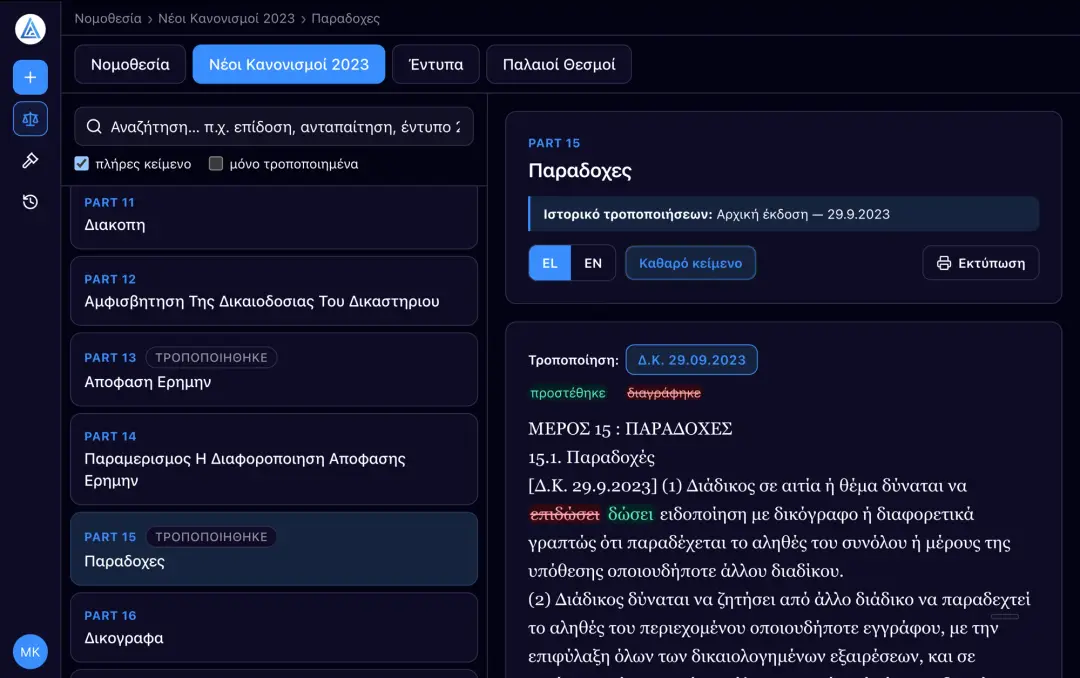
The 2023 change to Part 15 shows why amendment history matters. Rules 15.1 and 15.4 originally required a notice of admission to be served (επίδοση); since 29 September 2023 it is given or delivered (δίδεται, παράδοση). A ruling on admissions from before October 2023 may be reading the old wording.
Where do you find the prescribed forms?
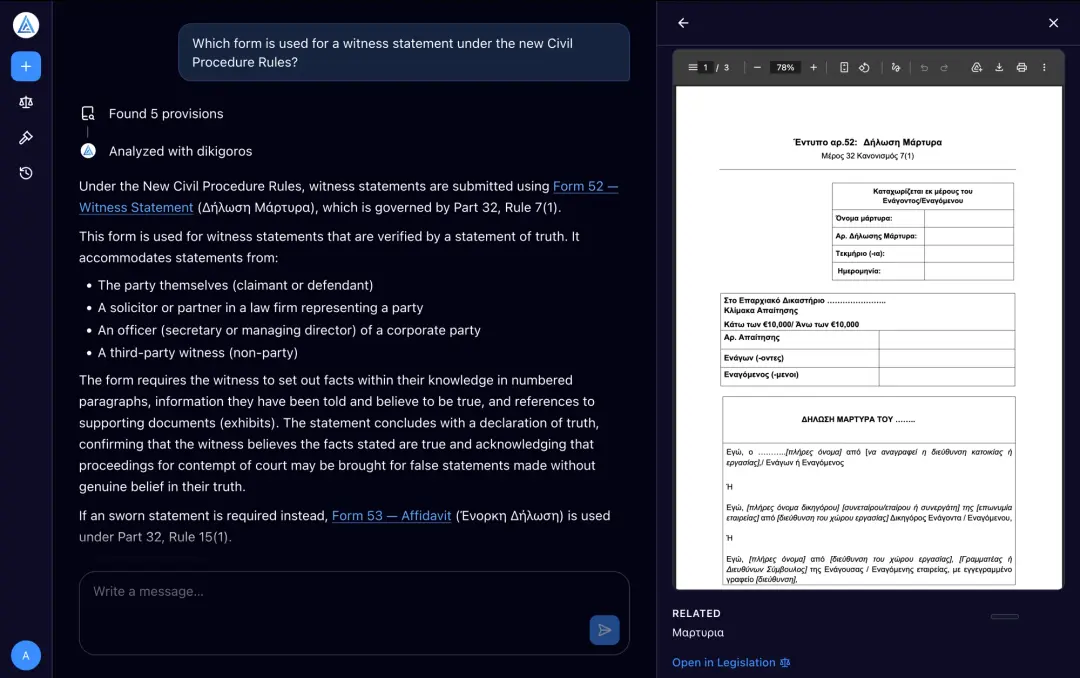
Appendix A holds the forms (Έντυπα): 1 to 62, ΕΕ63–ΕΕ65 for appeals, ΝΑΥ66–ΝΑΥ91 for the Admiralty Court and 92–100 for arbitration and enforcement. Part 4 requires them to be used where they apply, varied only as the case requires. The official set is on the Supreme Court website with the consolidated text and on cylaw.org. Form 4 has been replaced three times, so always use the current version.
How are the courts interpreting the new Rules?
How much case law is there? Original data from the DIKIGOROS AI index
We counted decisions that refer to the 2023 Rules by name (for example "Κανονισμών Πολιτικής Δικονομίας του 2023" or "Νέων Κανονισμών Πολιτικής Δικονομίας") and decisions that refer to the old Θεσμοί.
| Year | Decisions citing the 2023 Rules | Decisions citing the old Θεσμοί |
|---|---|---|
| 2023 | about 30 | about 670 |
| 2024 | about 160 | about 730 |
| 2025 | about 320 | about 640 |
DIKIGOROS AI index, September 2026. Full-text match on the names of the Rules; 2026 is a part year and omitted.
NCPR case law grew about fivefold from 2023 to 2024 and doubled in 2025, to about 540 decisions in total. Still, in 2025 the old Rules were cited about twice as often, because pre-September 2023 cases are still being tried. About 240 of the 540 come from the District Courts (see the District Courts of Nicosia, Limassol, Larnaca and Paphos), about 140 from the Court of Appeal and about 65 from the Family Courts.
The Parts mentioned most often alongside the 2023 Rules are Part 23 (applications, about 150 decisions), Part 1 (about 125), Part 41 (appeals, about 120) and Part 3 (about 100), then Parts 39, 25 and 60 at about 50–60 each (indicative counts).
Early Court of Appeal decisions
CTC Automotive Ltd v. Ψαρούδης Μπετόν Λτδ κ.α., Civil Appeal Ε112/24, 28 March 2025. On an application to strike out an appeal as manifestly unfounded under rule 41.9, the President of the Court of Appeal held that failing to file the appointment-of-advocate form is a curable irregularity, especially where the party confirms its advocate. Saving the step was consistent with the overriding objective. Later Court of Appeal rulings have relied on it.
Evripides Demetriou v. METLIFE EUROPE D.A.C., Civil Appeal Ε64/2025, 8 October 2025. A claim filed in the Limassol District Court on 12 February 2025 was dismissed on summary judgment under Part 24 on 6 June 2025, and the appeal was struck out as manifestly unfounded under rule 41.9. Claim form to final appellate disposal took under eight months.
The pattern: Part 1 saves harmless defective steps, while Parts 24 and 41.9 dispose quickly of hopeless claims and appeals.
How DIKIGOROS AI helps with the Cyprus Civil Procedure Rules
DIKIGOROS AI holds the old Civil Procedure Rules and the NCPR 2023 with the prescribed forms and amendment history, searchable alongside 95,623 Cyprus court decisions.
- Rule, form and case law together. Ask in English or Greek and get the rule, the prescribed form and the judgments that interpret it, each footnoted.
- Amendment history. Amended provisions show tracked changes per amending rule, so you can see the text in force on your date.
- Old and new Rules side by side, while both tracks run in parallel.
- Citation explorer. See which later decisions followed a ruling such as CTC Automotive.
For how this compares with other tools, see the best AI legal research tools for Cyprus.
Try asking: "What is the time limit to file a defence under the new Civil Procedure Rules, can the parties extend it, and which Court of Appeal decisions deal with a late defence?"
Every new account starts on Free, no card needed. Create your free account at dikigoros.ai/register. You can stay on Free or choose Basic (€5 a month) or Professional (€20 a month). Professional comes with a 3-day free trial; card required, cancel any time before it ends. Law firms and in-house legal teams can choose Firm (€45 per seat a month), which adds Matters (case-file workspaces where you upload the documents for each matter and pin the authorities you rely on), seats and a firm dashboard. Prices exclude VAT; see pricing.
Conclusion
Three years in, the Cyprus Civil Procedure Rules 2023 mean stricter timetables, fewer technical knock-outs and faster disposal of weak cases. Practitioners still work both tracks, so the question is always which Rules, which version and which ruling. Start your free 3-day Professional trial at dikigoros.ai/register (card required) to search the Rules, forms and case law together.
Frequently asked questions about the Cyprus Civil Procedure Rules 2023
When did the new Civil Procedure Rules come into force in Cyprus?
The Cyprus Civil Procedure Rules 2023 apply to proceedings filed from 1 September 2023, and to the Court of Appeal from 3 July 2023. The Supreme Court approved them on 19 May 2021.
Do the new Rules apply to cases filed before 1 September 2023?
No. Those cases continue under the old Civil Procedure Rules (Θεσμοί Πολιτικής Δικονομίας). When exercising a discretion in an old case, the court may take into account the principles of the new Rules, particularly Parts 1 and 30 (rule 60.2).
How long does a defendant have to file a defence under the Cyprus CPR 2023?
The defendant enters an appearance within 14 days of service of the claim form (rule 10.4), then files a defence within 28 days of the appearance (rule 17.4). The parties may agree to extend this by up to 42 days in total, and the court must be told in writing (rule 17.5).
Which Part of the Cyprus Civil Procedure Rules covers summary judgment?
Part 24. The court may give summary judgment against a claimant or defendant, on the whole claim or an issue, if that party has no real prospect of success and there is no other compelling reason for a trial. Default judgment is a separate procedure in Part 13.
Are there pre-action protocols in Cyprus?
Yes. Part 3 and its Annex I set out Protocol I (specified sums), Protocol II (road traffic and personal injury) and Type III for other cases. Under Protocol I the proposed defendant must reply within 14 calendar days, and non-compliance can affect case management and costs.
What is the small claims limit under the new Rules?
€10,000. Claims for €10,000 or less, or where the claimant is unlikely to recover more, are small claims under Part 29 (rule 28.1). Larger claims are ordinary claims under Part 30.
How long do you have to appeal under the NCPR?
42 days from a final judgment and 14 days from an interlocutory decision (rule 41.2(2)). Since 26 July 2024 the notice of appeal must be served within 28 days of filing, previously 21.
Have the Cyprus Civil Procedure Rules 2023 been amended?
Yes, by amending rules published on 29 September 2023, 13 October 2023, 26 July 2024 and 7 August 2026. The 2026 amendment concerns only the Admiralty Court (Part 43).
Sources
- Κανονισμοί Πολιτικής Δικονομίας του 2023, Δ.Κ. 13/2023, Ε.Ε. 3.7.2023, cylaw.org
- Amending rules: (No. 1) 2023, (No. 2) 2023, (No. 1) 2024, (No. 1) 2026
- Supreme Court of Cyprus, consolidated text and forms; CyLaw, Νέοι Κανονισμοί Πολιτικής Δικονομίας; old Rules, Order 21 on cylii.org
- Ministry of Justice and Public Order, "Courts' Reform", gov.cy/mjpo; European Commission, "Modernising the Civil Procedure Rules in Cyprus"
- Court of Appeal judgments cited above (CyLaw); DIKIGOROS AI index, September 2026
- Related: CyLaw explained: the complete guide to Cyprus case law and legislation
Last reviewed 28 October 2026. General information, not legal advice. Only the Greek text published in the Official Gazette is authentic.