The hours go into joining the file to the law
A litigation file is rarely one document. It is a statement of claim, a defence, a police certificate, a hospital discharge note, an expert report, an insurer's letter, payslips and the client's own account, some typed and some scanned. The case law sits somewhere else entirely.
Reading each part is not what takes the time. Connecting them is: finding the paragraph of the expert report that matters, then finding the judgments where a court valued a similar injury, then checking that what you write about one matches the other. General chatbots have no Cyprus database to help with the second half, and most firms rightly keep client files out of them.
To show what changes, we built a file on our own account and worked it from start to finish. The case, Παναγή v. Κυπριανού κ.ά., claim no. 2317/2025 before the District Court of Nicosia, is invented, and so is every name in it. It is a personal-injury claim by a motorcycle courier against a driver who turned across his path, and the driver's insurer.
The screenshots below come from this Greek test file, so the app is shown in Greek. Matters works the same way in English: the interface, your documents, your questions and the answers can all be in English.
Step 1: Upload the case file
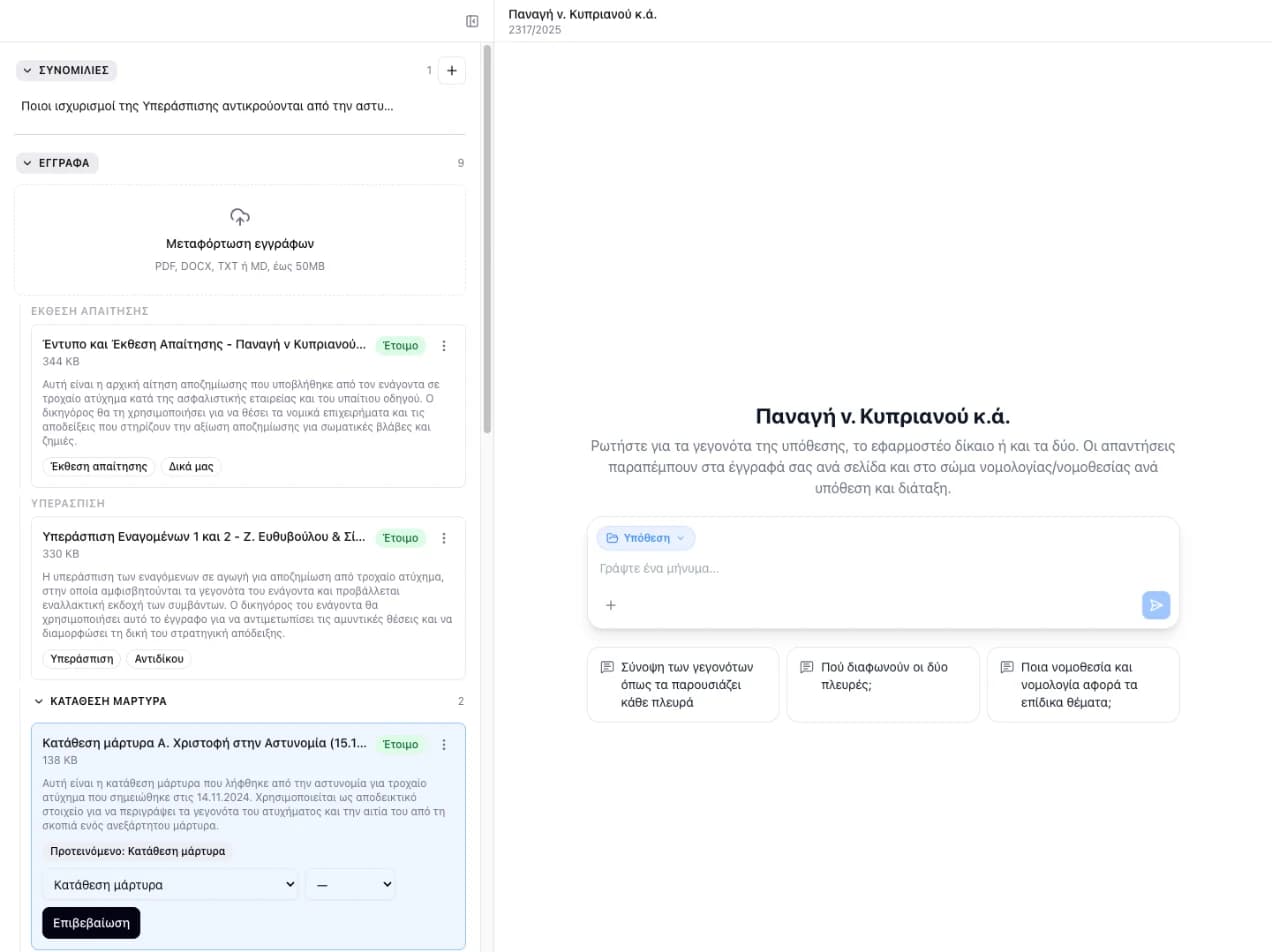
We created the matter and uploaded nine documents: the statement of claim (12.06.2025), the defence of defendants 1 and 2 (29.09.2026), the Nicosia General Hospital discharge certificate, the Strovolos police certificate of the accident, a witness statement to the police, the orthopaedic expert report of Dr P. Neokleous (22.06.2026), the insurer's "without prejudice" letter offering €18,000, the employer's certificate with two months of payslips, and the client's own notes.
Each document arrived with a suggested role (statement of claim, defence, exhibit, expert report, correspondence and so on), a side (ours or theirs) and a two-sentence summary of what it is and what a lawyer would use it for. The documents are grouped by role in the case-file pane. Where a suggested role or side is wrong, you change it in two clicks.
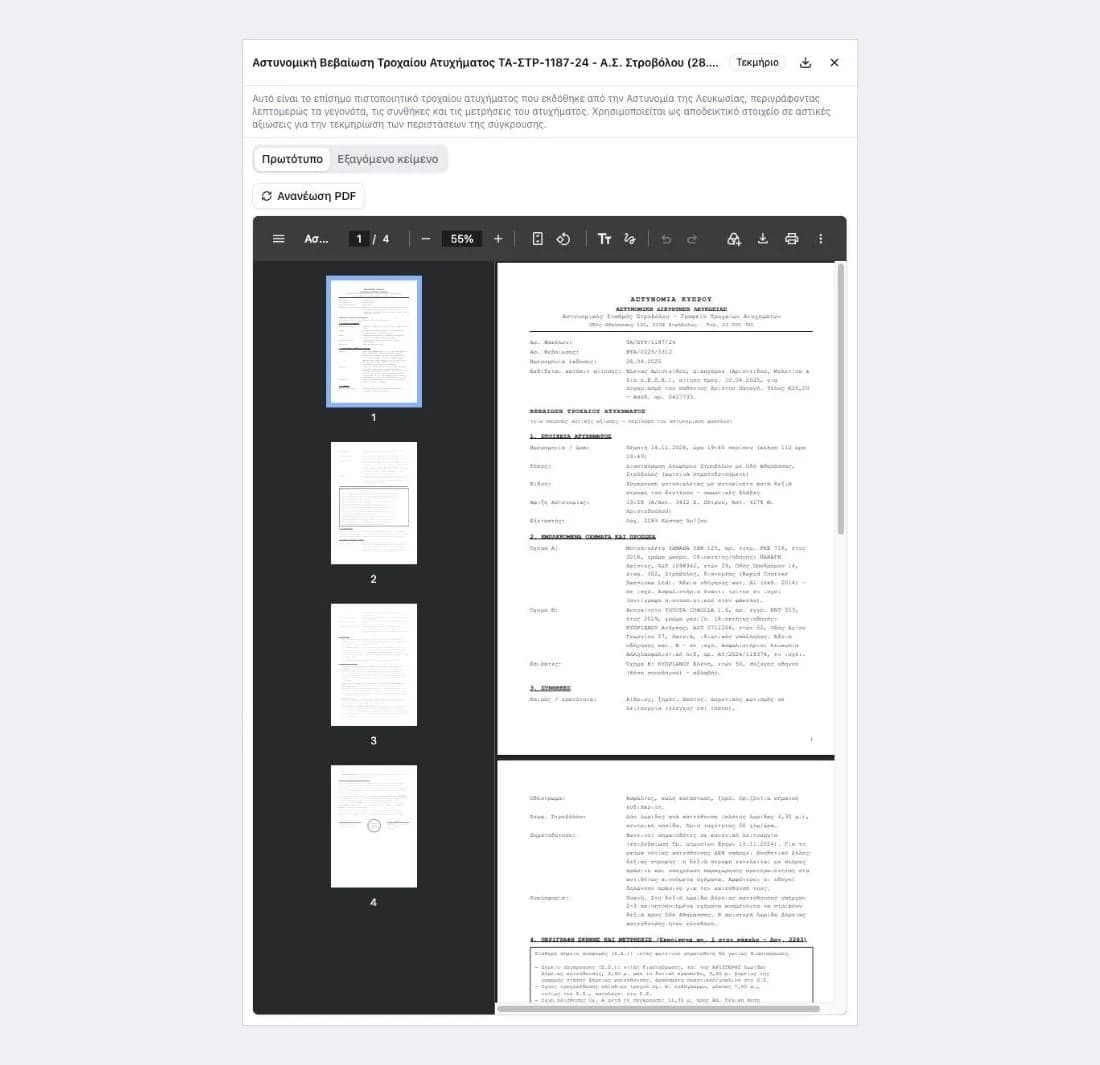
Scanned pages are read too. A photocopied police certificate or a hospital note scanned at the front desk goes through text recognition, so the AI can search and quote it like any typed document.
Step 2: Pin what you already rely on
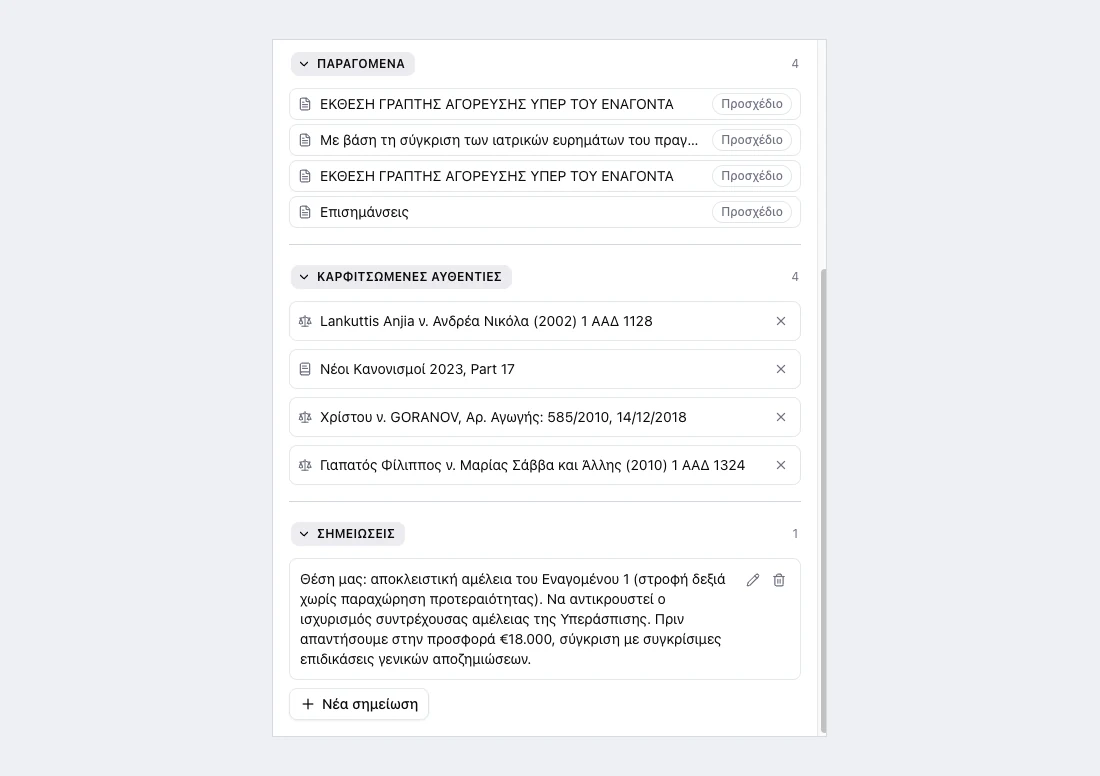
Most files start with authorities the advocate already has in mind. In this one we pinned four to the file: Γιαπατός Φίλιππος ν. Μαρίας Σάββα και Άλλης (2010) 1 ΑΑΔ 1324, Lankuttis Anjia ν. Ανδρέα Νικόλα (2002) 1 ΑΑΔ 1128, Χρίστου ν. Goranov (Αγωγή 585/2010), and Part 17 of the NCPR 2023. (More on the new rules in our NCPR 2023 guide.)
Pinned authorities sit in the file next to the documents, so the AI treats them as part of the case. Notes hold what only you know: the client's instructions, the line you intend to take on contributory negligence, the point you want checked before trial.
Step 3: Ask the case a question
Then you ask, in Greek or English, the way you would ask a colleague who had read the whole file: "Which of the defence's allegations does the police certificate contradict?" or "Summarise the facts as each side presents them."
The answer cites the client's documents by page, such as «Ιατρική Έκθεση, σελ. 3», beside Cyprus judgments and provisions. Every citation is a link. Click a document citation and that page of the document opens beside the chat; click a judgment and the judgment opens.
The key moment: the expert report against the case law on general damages
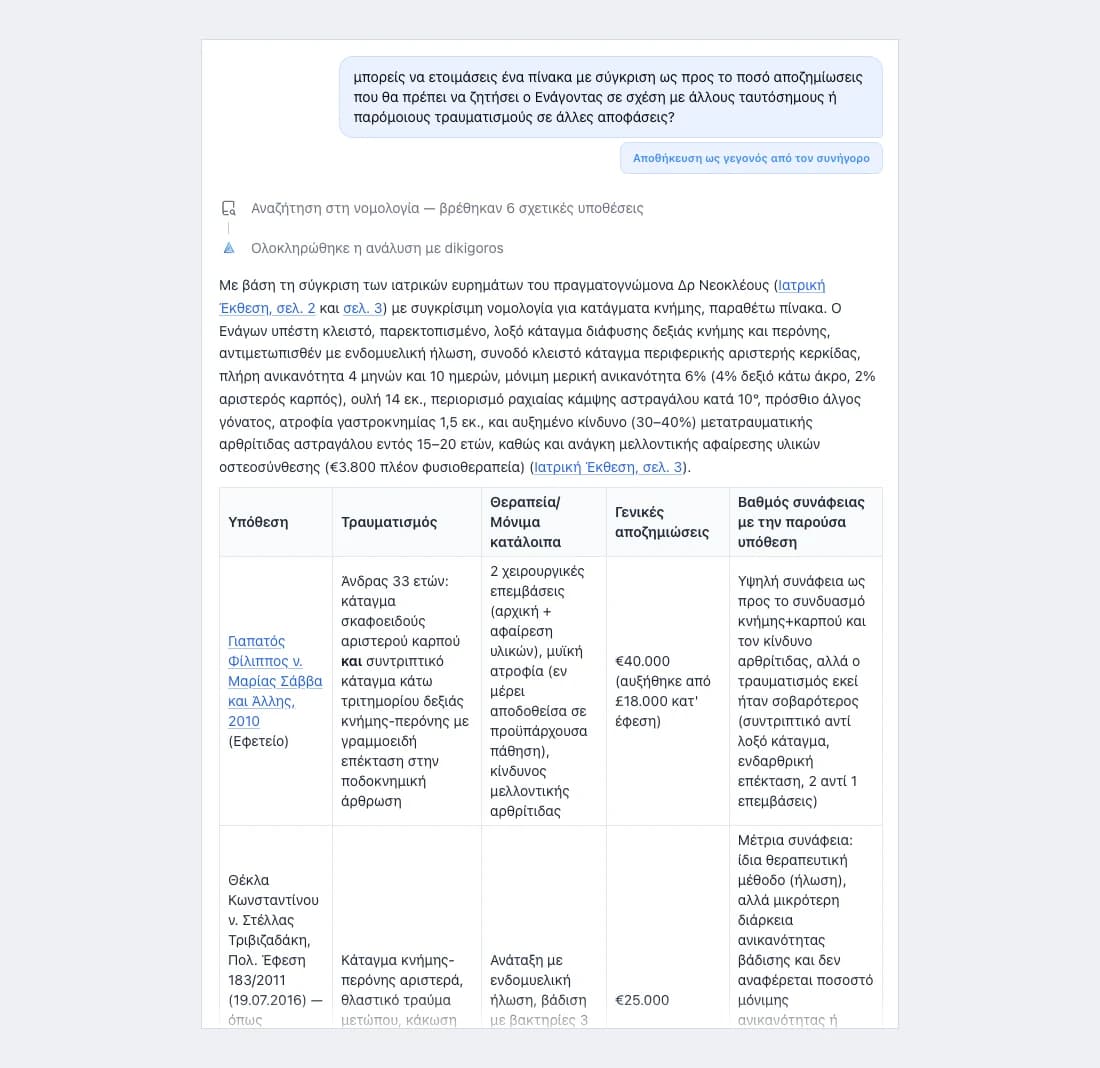
The question that shows the point of Matters is the one that needs both halves of the work at once. We asked the file to compare the expert's medical findings with comparable Cyprus case law on general damages.
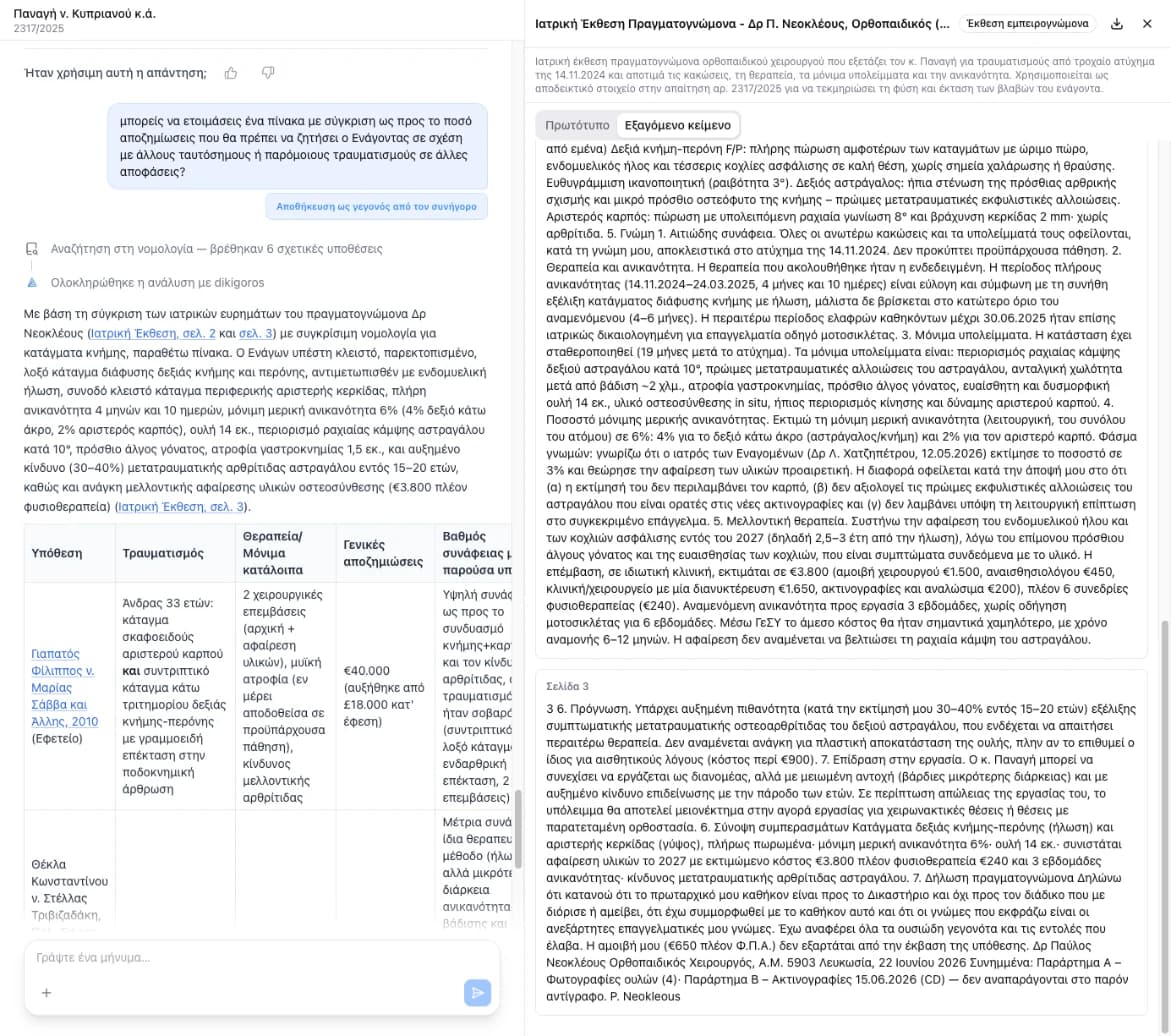
The answer began with the client's file. Citing the expert report at pages 2 and 3, it set out the injuries: a closed, displaced oblique fracture of the right tibia and fibula treated with intramedullary nailing; a fracture of the distal left radius; total incapacity of four months and ten days; permanent partial disability of 6%; a 14 cm scar and a 10° restriction of ankle movement; a 30–40% risk of post-traumatic ankle arthritis within 15–20 years; and €3,800 for future removal of the metalwork, plus physiotherapy.
It then set those findings in a table beside comparable awards, each row linked to the judgment and rated for how close it is to ours. Among them:
| Case | Injury | General damages | Relevance, as the answer assessed it |
|---|---|---|---|
| Γιαπατός ν. Σάββα (2010) | Fractured left scaphoid and comminuted fracture of the right tibia and fibula extending into the ankle joint; two operations | €40,000 on appeal | High on the leg-and-wrist combination and the arthritis risk, but a more serious injury |
| Κωνσταντίνου ν. Τριβιζαδάκη (2016), as cited in Χρίστου ν. Goranov | Fractured left tibia and fibula, treated with intramedullary nailing | €25,000 | Medium: same treatment, but no recorded permanent disability or arthritis risk |
| Lakmini Kumari ν. Ρούσου (2011) | Fractured femur, not tibia, with nailing and future removal of metalwork | €33,500, of which €1,500 for the future operation | Low to medium: a different bone, useful on how future surgery is awarded |
| Lankuttis ν. Νικόλα (2002) | Amputation of the right leg, multiple fractures, 12 operations | £100,000 on appeal | None directly: listed only as the top of the scale |
The full table had six rows. Its assessment placed our client's injuries between Κωνσταντίνου at €25,000 and Γιαπατός at €40,000, because of the injury to two limbs, the documented 6% permanent disability and the specific arthritis risk.
What persuades us most is what the answer said it could not do. It flagged that Κωνσταντίνου was found only as a citation inside Goranov, so its details could not be fully verified. It said the final award in Goranov could not be confirmed from the text available, and suggested a narrower search. And it noted that none of the comparables concerned a professional motorcycle courier, which matters for loss of earning capacity. That is the behaviour you want from a junior: the work, plus an honest list of what still needs checking.
Clicking «Ιατρική Έκθεση, σελ. 3» opened the expert report at that page, beside the chat, so the injury list could be checked against the doctor's own words in seconds.
From answer to work product
You can save any answer as an output of the file, export it to Word or print it, with its citations written out in full. Once you have checked it and marked it verified, it becomes a document of the file, and later questions can rely on it like any other.
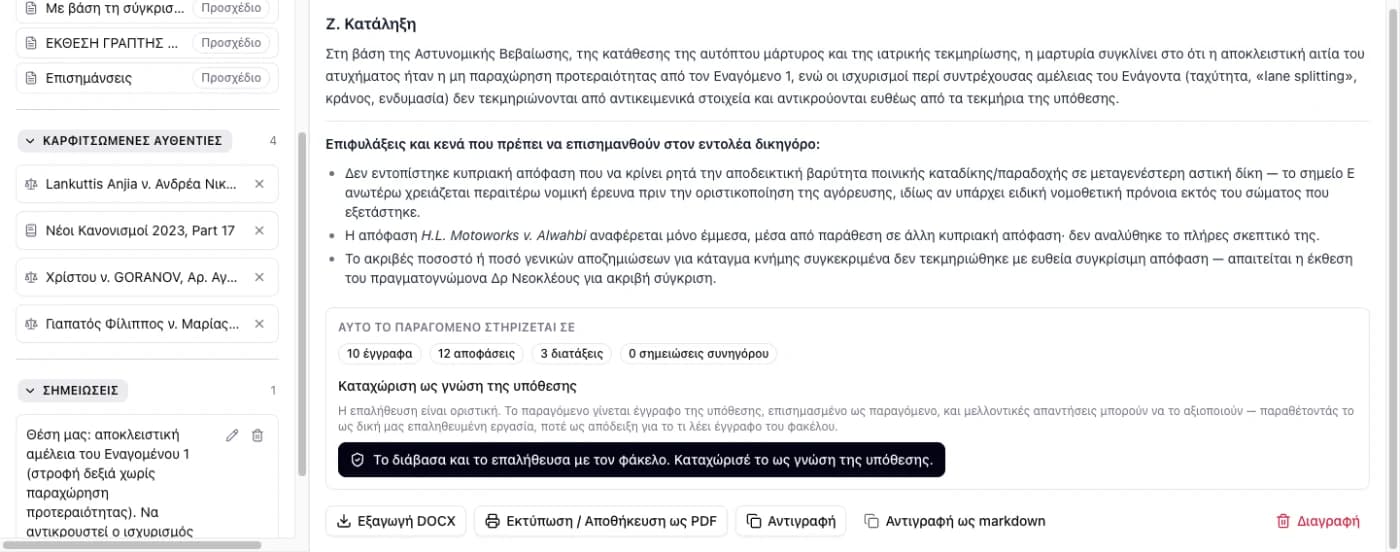
In our file we asked for a draft written submission for the claimant (Έκθεση γραπτής αγόρευσης). The draft opens by framing the accident as the sole fault of the first defendant, who turned right without giving way to the claimant's motorcycle, and supports it from the file: the police certificate at page 4 and the eyewitness statement at page 1, quoting the witness's words that the car turned sharply without indicating. It then sets out the objective standard of the reasonable driver and draws on District Court and Supreme Court decisions with similar facts, explaining why each helps and how one apparently unhelpful authority in fact supports the claimant. The draft is saved in the file, marked as a draft, ready for the advocate to edit, verify and finalise.
The same works for the rest of a litigation practice: letters to the other side, opinions to the client, a reply to a defence, a list of issues for a pre-trial review.
The advocate stays in charge
The AI finds and drafts. The advocate checks and decides. Every proposition in an answer can be traced to its source, either a page of the client's file or a judgment or provision, and the answer says where its sources run out. As with any research tool, verify what you cite before you file it; our guide on citing Cyprus judgments sets out how.
On confidentiality: uploaded files are stored in the EU (Frankfurt), and neither DIKAI nor its sub-processors use customer content to train AI models. Deleting a matter deletes its chats at once and erases everything else in it within 30 days. The details are on our Trust page.
Frequently asked questions
Is my client data used to train AI models?
No. Neither DIKAI LTD nor its sub-processors use customer content to train AI models; this is a contractual commitment in our Data Processing Agreement.
Where are the documents stored?
Uploaded files are stored in the EU, in Frankfurt. AI processing uses the providers listed on our sub-processors page; the Trust page sets out the details.
Can it read scanned documents?
Yes. Scanned PDFs are read by text recognition, so a scanned police certificate or medical note can be searched, quoted and cited by page like a typed document.
Does it work in Greek?
Yes. You can ask in Greek or English, the documents can be in either language, and answers cite Greek judgments and provisions directly.
How many cases and documents can a firm hold?
Each firm member can have up to 10 active case files, with up to 50 documents in each. Supported uploads are PDF, Word (.docx), .txt and .md files, or pasted text.
How do I see it on our own files?
Book a 30-minute live demo. We walk through a case file with you, and you can bring the kind of matter your firm handles every day.
Conclusion
Matters does not ask a firm to change how it works a file. It reads the file the way an advocate does, joins it to Cyprus case law and legislation, and shows its sources at every step, so the hours go into judgment rather than searching. Matters is part of the Firm plan, at €45 per seat per month (prices exclude VAT where applicable).
The best way to judge it is to watch it work. Nicolas Georgiades, advocate, runs a 30-minute live walkthrough for law firms. Book a 30-minute demo with a firm email address, and see a case file like yours answered with its sources. For how Matters sits among other tools, see our comparison of AI legal research tools for Cyprus.
The case, the parties, the doctor, the witness and the insurer in this post are fictional. General information about a software product, not legal advice.